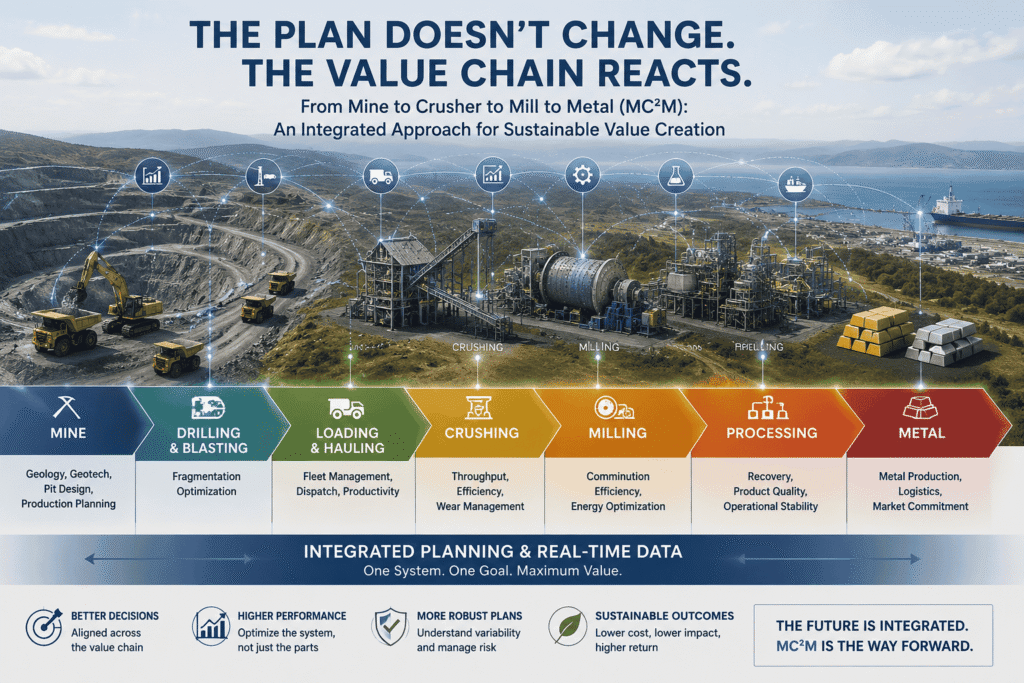
The mine plan is not the system. It is only one component of a much larger value chain.
Too often we analyze planning as an isolated activity. In reality, every decision propagates through an interconnected production system:
Geology → Mine Planning → Drilling & Blasting → Loading & Hauling → Crushing → Grinding → Processing → Metal
A change in geology modifies the plan. The revised plan changes blasting. Blasting changes fragmentation. Fragmentation changes crusher performance. Crusher performance affects mill throughput. Mill performance influences recovery and ultimately the value of the final product. Etc.
This is why local optimization frequently produces global instability.
A department may optimize its own objectives while unintentionally degrading the overall performance of the operation. Geotechnical recommendations, maintenance constraints, production targets, plant limitations or metallurgical requirements are all valid decisions when viewed independently. However, once combined, they interact in ways that are often invisible until they reach the mine plan.
Planning should therefore evolve from schedule generation to value-chain integration.
The real question is no longer: “Why does the plan keep changing?”
A more useful question is: “What is the entire Mine-to-Crusher-to-Mill-to-Metal (MC²M) system reacting to?”
Once the source of variability is identified, we can evaluate whether it improves or degrades the performance of the complete value chain rather than a single department.
From planning to systems engineering
Digital twins, integrated planning platforms, simulation and artificial intelligence are valuable because they reveal how uncertainty propagates across the complete mining system. Their objective is not to eliminate variability—mining will always be uncertain—but to make the consequences of decisions visible before they affect production.
The future of mine planning is not simply producing better schedules. It is designing a more resilient Mine-to-Crusher-to-Mill-to-Metal system, where every discipline understands how its decisions influence downstream performance and, ultimately, project value.
What do you think? Has mine planning become a system integration discipline rather than a scheduling discipline?